Showing posts with label ecology. Show all posts

Weather Channel has article that agrees with us

10:52 PM Reporter: Justin 0 Responses
This article discusses how different religious groups have taken a stand for the environment because of their view of God as the Creator. I find it interesting that an AP writer is actually giving credence to the side of the issue that concerns me.

Read more...

Obama and Geo-Engineering

1:12 PM Reporter: Justin 1 Response

Obama's science advisor has stated publicly that he thinks the idea of geo-engineering is the way to hold off global warming (here). I find this idea interesting. I love technology. I love God's creation. But, I am unconvinced about global warming. I've yet to see any good data supporting real warming over any extended amount of time that doesn't mimic natural patterns in the past. If you are aware of this data please leave a link in the comment section!!

The basic idea that Obama's science advisor suggests is that we should use technology to stave off the radical global warming that "could be approaching" (his words in the article). Holdren's idea includes creating a device which would launch particles into the upper atmosphere much like a volcano. To be fair, it is widely accepted that a volcanic eruption was in large part the cause of the "Little Ice Age" (data here). However Holdren himself notes that the effects of such a device are unknown.

Anyone who has read even a little bit about Chaos theory (a good book here, and article here) knows that a complex system with many variables is basically impossible to predict. This is because the same patterns can be caused by different sets of variables. So, scientists really don't know what the effect of this device might be, but Holgren is ready to say that he thinks it is the best bet in the fight against what might be catastrophic global warming.

I would rather see our nation (and Christians in particular) embrace a lifestyle that uses the fewest resources possible, causing the least pollution possible, and only leaving a mark upon human culture, not a scar in the land.

Read more...

Recycling as an Act of Worship: An Argument from the Old Testament

10:18 AM Reporter: Justin 0 Responses
I recently presented a paper with this title at the Southwest Regional meeting of the Evangelical Theological Society. The paper was well-received, though I would have wished for more input (don't we all!).

The basic argument of the paper proceeds like this:
1. Worship in the Bible is defined as fulfilling God's commands.
2. One of God's commands is to care for his creation.
3. Creation Care is an act of Worship.
4. Qualifications for what makes an act of service (e.g. creation care) an act of worship.
5. Recycling is an act of Creation Care.
6. Recycling is an act of Worship, and conclusions...

You can read the paper at: http://www.clickcaster.com/conservativeecology

Read more...

Old Testament Ecology in Lifegroup

12:27 PM Reporter: Justin 0 Responses

Tonight, I'll be teaching at our lifegroup. Hopefully I'll be a discussion leader more than anything. I hope the insights I offer will be of use to everyone in the group. I'll probably try to post my outline and possibly a recording of the session (podcast). Pray for me as I prepare, and bring the word.

Read more...

Being Ethical while fighting for the Environment

9:03 AM Reporter: Justin 2 Responses
A few recent events have led me to believe that Christians who view ecology as something important (in other words they are "green"), need to have thought through some ethical questions. How does one relate to those with whom they disagree? How far is one willing to go in pursuing "greener" goals?

One should honor and respect those who are not "green" because they are the image bearers of God, even if they disagree with you. Unfortunately, some people take their environmental agenda so far, that they are wiling to harm other humans who get in the way of their goals (see story here). This type of behavior must be condemned by Christians, even those who are "green". This is because of the Christian ideal of "treating others as you want to be treated" which is a proverb based upon biblical truth.

Still, the environmentalists (except for the deep ecology people) have as their goal the preservation of the planet for humans. So, how does hurting humans to save the planet fit in? It simply does not work. Their logic deconstructs.

A town in Spain has erected solar panels over a graveyard in order to pursue a greener supply of energy (see article here). Does this cross some sort of a line in respecting human dignity? Some would argue that this does cross a line. While I am not yet ready to take a position on this (I haven't thought it through enough) I do believe that Christians should respect human dignity. For me, this means that we should not engage in abortion or the euthanizing of the mentally challenged for population control. Of course, protestants have generally thought of birth control as acceptable (although one Southern Baptist recently went against this, here).

So there are several issues for the Christian to think through regarding the issue of how far one should go to pursue a green agenda. However, one can and should always treat other people in teh way that Christ did, with respect and honor -even those we disagree with.

Read more...

Poorly Cited Ecology Articles

4:01 PM Reporter: Justin 1 Response
MSNBC tends to run poorly cited articles about the environment. I think this is exactly why some groups discount the environmental emphasis or "green movement". In a recent article on water shortages (read it here), the story comes with no evidence to back up its claims. The story mentions one scientist whom the story says "Wong said the U.N. Intergovernmental Panel on Climate Change found that as many as 2 billion people won't have sufficient access to clean water by 2050." The problem with that statement is that the story gives no context to it. There is no mention of when and where Dr. Wong said this, or what study his statement was based upon. In short, there is no way for the reader to judge the validity of his claim.

Basically this type of writing is little more than propaganda. That is precisely why some groups doubt that climate change is happening. Environmental groups cry out that oil companies are distributing "misinformation" in an attempt to stifle environmental groups and increase their profits. This may be the case - but as long as environmental articles are written like the one mentioned at MSNBC, no reader will be able to make an informed judgment. We need facts, we need evidence, we need citations or at least the mention of where the information came from.

Read more...

Fungus - the God's gift and curse?

4:01 PM Reporter: Justin 0 Responses

Fungus. (the image is property of Gary Strobel, Montana State Univ.) The mention of the word brings to mind an old Seinfeld episode where he thinks a girl he's dating has some sort of fungus. The episode makes us laugh at the way we treat people who have a fungus. I'm sure most of us have had something like a fungus - be it athletes foot or something else in our lives. So, fungus can be a curse.

But it can also be a blessing and a gift. Mushrooms are tasty treats, which can grow quickly and provide nutrients. Recently, a scientist discovered a fungus in the Amazon which produces hydrocarbons as a byproduct from plant matter. This stuff has them re-thinking the way oil deposits were created. Can you imagine what the world would be like if farmers could get rid of their byproducts (stalks, etc.) and then convert it into fuel? Of course, burning hydrocarbons would still produce pollution. However, one step in the equation of solving the world's energy woes would be solved through incorporating these fungi. It's intriguing isn't it!

Read more...

Pot more harmful than you think

12:46 PM Reporter: Justin 0 Responses
I found a story on MSNBC about the environmental dangers that Pot growing is causing in the USA (story here). Whether you think smoking pot is wrong or not (Illegal = wrong for me, plus it can't be good for you), it has some very bad environmental impacts.

I saw a documentary a while back on the history channel which portrayed the fight against pot growers in Tennessee by the parks and wildlife association. They were having to watch out for traps, and all sorts of things set to kill them -all set by those who were growing illegal crops of marijuana on gov't land. The msnbc article details how these pot growers are using harmful chemicals to increase their crop yield. Most of those chemicals were outlawed in the US back in the 70's, because of how harmful they are to wildlife. Additionally, the introduction of foriegn crops, the creation of new trails, and the presence of humans, would seem to negatively impact the environment of those areas.

National Parks are really going to take a hit from this if something doesn't change. Eventually the illegal poaching, and the pollution will impact the health of these ecosystems -if it hasn't already.

Christians are called to follow the laws of their land unless those laws prohibit the worship of God. Since smoking and growing marijuana are illegal, the Christian would do well to stay away from these things. Since the marijuana trade impacts God's creation so negatively, supporting it would also be supporting the misuse of God's creation.

For those of you who do enjoy marijuana, you might think about the possibilities of the chemicals used to grow the drug being more harmful than the drug itself...

Read more...

Economy Versus Environment

9:46 PM Reporter: Justin 0 Responses

Time.com (Time Magazine) ran an article with this title, which supports what I claimed about the "green" agenda losing its footing to the "economic agenda" (the picture is from the Time article). Could going green actually save the economy? The article also contained an interesting idea:

"So what should greens do to avoid irrelevance, now that Hank Paulson is replacing Al Gore as the nation's chief scold? First, tie environmental rescue to economic recovery, by "greening the bailout," as columnist Tom Friedman of the New York Times has put it. As the new Administration — whether Democratic or Republican — searches for ways to stimulate the economy, green infrastructure spending could be the way to go. More money for high-speed rail, tax credits for new solar systems, increased federal funding for renewable energy — these are policies that might not only help stimulate a flagging economy, but directly contribute to slowing the growth in America's carbon emissions. (Not to mention promoting green jobs at a time when unemployment is on the rise.) The challenge will be tactical: convincing Americans that curbing climate change is as much about overhauling a failed economy as it is about limiting carbon emissions. That message didn't get across during the debates over Lieberman-Warner; the next President and Congress will need to do better. "Addressing greenhouse gases and addressing the economy are all part of the same problem," says Barbour. "This is absolutely a top priority. It can't be postponed forever."" (from the article here)

Since there were huge government programs to get the country out of the Great Depression, maybe government programs could get the country out of the current economic funk. Imagine if we had tons of jobs and government money poured into creating a good rail network which could replace 18 wheelers (heck train those guys to run the new trains as a part of the program). We could reduce traffic, reduce emissions, and create jobs. Will it happen - not if either of the corporate candidates are elected (and one will be).

Read more...

Will "Sprawl" ever go away?

10:06 PM Reporter: Justin 0 Responses


California has signed legislation into law which will attempt to limit "sprawl" (click here for story). I admire the attempt to build communities near centers of work. However, some very obvious problems seem to stick out to me.

(The picture is from La Citta Vita)

1) Would people really want to live near factories, or other plants which pollute (air or noise or whatever)?

2) Usually, neighborhoods close to industry/business exist, but are undesirable. Does this law mean that these neighborhoods will be reclaimed (re-urbanized, or re-vitalized) so that property values rise exponentially driving the current inhabitants away? This seems to be the usual pattern in cities of "sprawl". Then they tend to bulldoze the existing structures to build larger houses. I'm not sure that this process would help the environment.

3) Will this law guarantee that the people who work at these places can afford to live in the planned community nearby? I would love to live in downtown Fort Worth, where I could walk to any store I would like. But, the price is triple (or more) what I currently pay in the suburbs for half the space (and no garage!). If only the elite can afford to do this, the environment will not really be helped by this process. In addition, the very people who currently live in that regional environment will become the subject of an unfair type of oppression by the elite.

Until these questions can be answered I don't think the California legislation will be effective, no matter how hard the "Terminator" threatens.

Read more...

Wall Street to kill "green" movement?

4:22 PM Reporter: Justin 1 Response
This was the worst day ever on Wall street. This isn't a blog about the economy or finances, but something this huge will affect other sectors of life. I'm interested to see if gas prices become crazy volatile again as traders sink money into commodities. It's pretty much guaranteed that a financial crunch stifles investment in future technology, like green technology.

Was this crash something that could have been helped? Who knows. You'll get the same old spin: Republicans will blame democrats, Dems will blame the GOP. Isn't the greed of big business really to blame here? If the banking companies had not created this mess by pursuing ginormous profits, would we crying today? (I say crying because all of us lost money today on the market if you have a retirement account or even a money market account).

Read more...

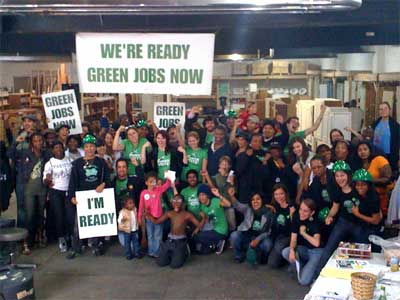
Green Jobs; Green Economy - Really?

10:34 AM Reporter: Justin 2 Responses

I found out (here) that there is a movement to create "green" jobs here in the 'ol US of A. The only problem for me is that I don't really understand what that means. I found out that there is even a designation of "green collar worker". The wiki article on it says:

A green-collar worker is a worker who is employed in the environmental sectors of the economy, or in the agricultural sector. Environmental green-collar workers satisfy the demand for green development. Generally, they implement environmentally conscious design, policy, and technology to improve conservation and sustainability. Formal environmental regulations as well as informal social expectations are pushing many firms to seek professionals with expertise with environmental, energy efficiency, and clean renewable energy issues. They often seek to make their output more sustainable, and thus more favorable to public opinion, governmental regulation, and the Earth's ecology.

Green collar workers include professionals such as conservation movement workers, environmental consultants, environmental or biological systems engineers, green building architects, holistic passive solar building designers, solar energy and wind energy engineers, nuclear engineers [1], green vehicle engineers, organic farmers, environmental lawyers, ecology educators, and ecotechnology workers. They also include vocational or trade-level employment: electricians who install solar panels, plumbers who install solar water heaters, and construction workers who build energy-efficient green buildings, wind power farms, or other clean, renewable, sustainable future energy development workers could all be considered green jobs.

What I'm wondering is where will these jobs fit into the present "growth" economy? I'm not sure that they really will. As long as it is cheaper to ship jobs overseas and then ship the produce back here to sell it, these green jobs will have trouble taking hold. The american public, and goverment, is largely thinking in terms of bottom line (dollars). I think of it as a combination of Scottish Pragmatism (which has been influential in America) and Capitalism run amuck. Whatever is cheapest "works" and therefore is "best". Wal-Mart runs on this philosophy. But, is it always an ethical way of doing things? NO.One must also consider the means of the production, as well as the long term effects of it.

Maybe the American public needs these "green jobs" to create more employment. However, as long as big businesses fund and run politics, the bottom line mentality will dominate. I think we're a long way from incorporating green jobs into an economy unless big business can find a way of making more money from them.


Read more...

Science and Creation (ism)

5:24 PM Reporter: Justin 4 Responses

I recently read In the Beginning God: Modern Science and the Christian Doctrine of Creation by John Weaver. The title pretty much explains the thrust of the book. He presents a sort of synthesis of scientific ideas of origins and the Christian idea of origins. When speaking of the Christian tradition, he says,
“The relation between creator and creation is characterized by both distance (allowing freedom) and closeness (God’s attentiveness). There is a ‘letting be’ rather than a ‘must be’” (32). And then, “The fact that the first page of the Bible speaks of heaven, earth, sun, moon, stars, plants, trees, birds, fish, and land animals is a sign that God is concerned with these as well as humans” (33).

Then Weaver discusses humanity’s responsibility in dealing with the earth as God’s creation:
“For human beings to ‘have dominion’ over nature is a challenge to human beings to act with God, imitating his loving kindness and faithfulness with the whole of creation” (124). And then he asks, “To whom does the earth belong? ‘The earth is the LORD’s’, and God has given it to us. But it is a leasehold – to rule on God’s behalf. Our unique relation with God leads to our ability to think, choose, create, love, pray, and exercise control. Research, discovery, and invention in biology, chemistry, physics, and other spheres, and in all the triumphs of technology, are part of our God-given role. We co-operate with the processes of nature, we do not create them. God has entrusted us – we are caretakers, not landowners. The Year of Jubilee teaches us that we do not hold the freehold rights. Goods are meant for everyone; they are to be shared” (125).

This view of humanity’s role comes with certain ethical implications:
“Justice means that Christians should work to get people out of poverty. Meeting their needs once is not justice. IN addition, land should not be owned by corporations, but should belong to the people” (126). Then he remarks, “As we noted earlier, Gustavo Guitierrez challenges the church to recover the biblical call to give all people the dignity which is achieved through the climination of exploitation and poverty, which prevent the poor from being fully human. Jesus said, ‘I have come that they may have life, and have it to the full’” (127).

For Weaver, the idea of God as creator gives rise to a Christian pursuit of righteousness in terms of land-resources and poverty. He says:
“The uneven distribution, control, and use of natural resources are serious justice issues; and the rapid depletion of non-renewable natural resources raises the questions of our responsibility to future generations. Poverty is a source of ecological destruction, but ‘unless the poor have alternative sources of food and basic needs like fuel, they too will wantonly destroy whatever natural environment is around them’” (129).

One other interesting point that Weaver makes has to do with the apparent discrepancy with viewing God as the creator of a good creation, and the reality of natural disasters that harm human beings. He says:
It is not fair to blame God for destructive disasters, and question his goodness, when we have the ability to change the circumstances. It is also a moral question for humanity. “We come face to face with God who, in his self-limiting love gives freedom of choice to his creation, and who himself lives with the consequences of such an action.” 118
Rather than question God, Weaver prefers that we question our own human judgment in allowing people to be put into harms way in the first place. After all, these natural disasters may be surprising, but their possibility is widely known.

So, Weaver’s book offers some interesting insight into the idea of God as Creator, that is so foundational in Christianity. He understands humanity as the caretakers of God’s good creation. Because of this fact, humanity has the responsibility of preserving justice in the land, and with its resources. Yet, he goes farther than some evangelicals (in the American sense) may be willing to go. One of his concluding statements is based on Romans 8:19-22, in which he says, “God created the earth, entrusted it to human beings, and will redeem the whole of creation. Part of redemption lies in human repentance of extravagance, pollution, and wanton destruction of the environment” (142).


Read more...

Morning in the Garden

8:11 AM Reporter: Justin 0 Responses

Today as I was walking from my car to the library at SWBTS, I realized that this morning was probably a lot like the mornings in the garden of creation.

The cool of the morning glides against my face, and gives me energy in my lungs. The sun glows behind the clouds. It's warm tones filter through the oak trees. The light shimmers on the dewy grass. The air smells clean. The air smells like trees, and flowers. The birds sing and call to one another. Everything seems to be coming awake as I drink my coffee.

I can almost imagine the story of Genesis 2 taking place in a setting much like this. The story portrays God as a gardener among his people.

How are we treating the garden? How are we treating the gardener?

Read more...

Climate Refugees

12:21 PM Reporter: Justin 4 Responses
I read an interesting post over at the NCC Blog. It was about Gustav evacuees, and it called them "climate refugees". I found this term intriguing. The wikipedia definition (while certainly not definite) describes a climate refugee as, "a displaced person caused by climate change induced environmental disasters. Such disasters are evidence of human-influenced ecological change and disruption to Earth's climate system, primarily through the emissions of green house gases."

So, properly speaking. I'm not sure Gustav evacuees qualify as climate refugees. There were hurricanes long before we had human induced climate change.

Ethically, what should we do about these people. Should we attempt to rebuild their homes? I'm not sure. Recently I've been thinking that it may be best (financially) for the government to spend money for the displaced people to start a life in a new place which isn't going to have the same potential for natural disasters.

Christians should seek to meet these people's needs in one way or another. I'm just not sure what the most responsible way of doing that is. Sending people back into harm's way may not be the best way of doing that. Of course those people have a right to live there, but in a sense they are taking responsibility for their own problems by going back instead of moving to a safer place.

I have a feeling this question is going to be on my mind in the weeks to come as Hurricane Ike broods in the Gulf of Mexico. We still have Katrina victims living among us in DFW years after that storm. Perhaps that was the best solution...perhaps not...

Read more...

TerraPass site reveiw

8:30 AM Reporter: Justin 0 Responses

I've been doing a little reading over at cleanmpg.com before bed lately. I noticed a little TerraPass graphic in some guys signatures, so I finally checked it out. The website is pretty cool, and looks great. The picture is one of their badges...

They have a store where you can buy energy saving devices, or even carbon credits. In addition, they have a pretty detailed carbon footprint calculator. I was a little disappointed in my results with it, because my energy provider uses all fossil fuel (it's a co-op so I can't opt out). This is especially disappointing when there is wind energy available close by at 4 cents per kwh cheaper than what we pay.

The site also details the company's projects (clean energy, farm power, and landfill gas capture).

For us Christians who wish to reduce our detrimental impact upon God's creation, this website will be somewhat helpful. It can suggest a few ways that you can lessen your carbon footprint as well as support a good cause. The only reason I'm not too excited about it is that I haven't seen any data supporting the validity of carbon offsets. Does anyone have any?

Read more...

Ethical Sustainability

5:44 PM Reporter: Justin 2 Responses
While forcing myself to take a sabbath today, I read an article by Jon Cobb Jr., "Ecojustice and Christian Salvation". In this essay he lists alternatives to treat the world in terms of a sustainable approach.

He first mentions viewing the world in terms of regions. This approach would want to let each region fend for itself, and its population would be dependent upon that regions economy resources for survival. In this way, each region's population will eventually balance in sustainable numbers.

Second, a global view would focus on the maximum carrying capacity of the planet. In this way, regions with more resources would pass some of those resources along to resource poor regions in order to raise the global standard of living, and keep it in line with a globally sustainable number.

Thirdly, he presents a view between these first two, in which the affluent would have to do less work towards sustainability. In other words, there would still be a rich class of people (like Americans).

A fourth possibility listed is for Christians to take responsibility for seeking out a sustainable lifestyle. In this view, Christians should recognize that not everyone can be counted on to live a lifestyle that will promote sustainability. Therefore, Christians should pick up the slack as a sacrifice to Christ.

This is an oversimplified view of what Cobb says, but it gets the point across. My question is: "Do we really have to choose something this extreme?" My first guess is that the answer may be "yes". I haven't fully thought this one through though. I'm trying to decide if the Christian idea of simplicity that was so central until the rise of Protestant Capitalism in Europe and America, needs to be revisited. If Christians were committed to living a simplistic lifestyle it would certainly help us to live "in this world, but not of it". I'm just not sure what this would look like yet.

Let me know what you think, and if you can see an alternative that Cobb has not mentioned.

Read more...

British Eco-Hypocrites

4:05 PM Reporter: Justin 0 Responses

Evidently most Brits are only "green" on a part-time basis. The article which details this can be found here. Interestingly, the farther up the scale of being committed to an earth conscious lifestyle, the more likely the people are to take long flights. Why does this seem odd to me? Long flights are supposed to be really bad for the environment.

To be fair, I suspect that most people here in the USA aren't as earth conscious as people in Britain, and Europe, and Japan. Even though many Texans aren't environmentalists, they are not hypocritical about it. But, that's neither here nor there.

I'm really interested if the data in this study was obtained through a survey or hard data. If it was a survey, then it is likely that many who were considered eco-saints lied about their behavior "on holiday".

This subject of earth conscious (or "green") vacationing gave me an idea. Why don't some airlines start a "green" fair? They could include an offset as part of the price of the ticket. I wonder how well those would sell.

I take trips to see family frequently. When we travel, we are definitely less careful about how we dispose of waste products, and where we eat. This has not been because of a conscious choice, instead it is because we -like the brits- don't think about it.

Read more...

Detriot Auto wants Government Money with No Stipulations

10:57 PM Reporter: Justin 1 Response
Free market economy shouldn't include government loans to bad businesses! The big 3 will be pushing for government loans this week, which they claim will help them through these dark times of the economy. But is the economy really in dark times (see the GDP growth projections) or is this just a market correction to weed out bad businesses, and bad business models?

Remember, that these are the same companies who have lobbied against the new mileage standards (here). So, they try and keep the MPG of their cars low, then can't sell them because nobody wants cars with low MPG's. Then, they cry that they need a government bailout because nobody wants their low MPG vehicles. Does this seem crazy to anyone else?

I say let the poorly run companies die. Honda's and Hyundai's and Toyota's are all assembled here in the USA. They don't seem to have any trouble selling vehicles, and aren't going bankrupt. Then again, they sell good vehicles in the USA. Ford makes good vehicles for Europe, but doesn't sell them here (they even offer a turbo diesel compact in outside the USA).

Anybody really think the government should loan them money?

Read more...

Joe Biden's Environmental Record

4:33 PM Reporter: Justin 0 Responses

After checking a couple of articles, it seems that Biden has record of making pro-environment choices. I should say that I am not endorsing Obama-Biden, or McCain-whoever. I will be voting for a third party candidate.

One article says, that he wants to take away the subsidies from oil companies. He voted to regulate mercury emissions from smokestacks. He voted no to more funding for forest roads and fish habitat. He voted YES on continuing desert protection in California. He voted to end commercial whaling and illegal trade in whale meat.

His website lists his position on some environmental issues. He has voted to try and slow climate change (here). He plans to reduce power plant emissions, and improve efficiency in cars and trucks. He hopes to protect Alaska's wildlife, and defend clean-air and water. Senator Biden co-authored the plan that provides debt relief to developing nations in exchange for protecting tropical rainforests that are critical to the global climate.

So, it seems that Biden has a record of being pro-environment.

Read more...