Showing posts with label science. Show all posts

Obama and Geo-Engineering

1:12 PM Reporter: Justin 1 Response

Obama's science advisor has stated publicly that he thinks the idea of geo-engineering is the way to hold off global warming (here). I find this idea interesting. I love technology. I love God's creation. But, I am unconvinced about global warming. I've yet to see any good data supporting real warming over any extended amount of time that doesn't mimic natural patterns in the past. If you are aware of this data please leave a link in the comment section!!

The basic idea that Obama's science advisor suggests is that we should use technology to stave off the radical global warming that "could be approaching" (his words in the article). Holdren's idea includes creating a device which would launch particles into the upper atmosphere much like a volcano. To be fair, it is widely accepted that a volcanic eruption was in large part the cause of the "Little Ice Age" (data here). However Holdren himself notes that the effects of such a device are unknown.

Anyone who has read even a little bit about Chaos theory (a good book here, and article here) knows that a complex system with many variables is basically impossible to predict. This is because the same patterns can be caused by different sets of variables. So, scientists really don't know what the effect of this device might be, but Holgren is ready to say that he thinks it is the best bet in the fight against what might be catastrophic global warming.

I would rather see our nation (and Christians in particular) embrace a lifestyle that uses the fewest resources possible, causing the least pollution possible, and only leaving a mark upon human culture, not a scar in the land.

Read more...

Science and Creation (ism)

5:24 PM Reporter: Justin 4 Responses

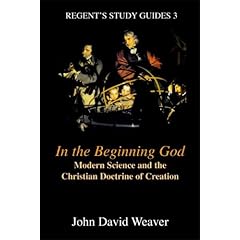
I recently read In the Beginning God: Modern Science and the Christian Doctrine of Creation by John Weaver. The title pretty much explains the thrust of the book. He presents a sort of synthesis of scientific ideas of origins and the Christian idea of origins. When speaking of the Christian tradition, he says,
“The relation between creator and creation is characterized by both distance (allowing freedom) and closeness (God’s attentiveness). There is a ‘letting be’ rather than a ‘must be’” (32). And then, “The fact that the first page of the Bible speaks of heaven, earth, sun, moon, stars, plants, trees, birds, fish, and land animals is a sign that God is concerned with these as well as humans” (33).

Then Weaver discusses humanity’s responsibility in dealing with the earth as God’s creation:
“For human beings to ‘have dominion’ over nature is a challenge to human beings to act with God, imitating his loving kindness and faithfulness with the whole of creation” (124). And then he asks, “To whom does the earth belong? ‘The earth is the LORD’s’, and God has given it to us. But it is a leasehold – to rule on God’s behalf. Our unique relation with God leads to our ability to think, choose, create, love, pray, and exercise control. Research, discovery, and invention in biology, chemistry, physics, and other spheres, and in all the triumphs of technology, are part of our God-given role. We co-operate with the processes of nature, we do not create them. God has entrusted us – we are caretakers, not landowners. The Year of Jubilee teaches us that we do not hold the freehold rights. Goods are meant for everyone; they are to be shared” (125).

This view of humanity’s role comes with certain ethical implications:
“Justice means that Christians should work to get people out of poverty. Meeting their needs once is not justice. IN addition, land should not be owned by corporations, but should belong to the people” (126). Then he remarks, “As we noted earlier, Gustavo Guitierrez challenges the church to recover the biblical call to give all people the dignity which is achieved through the climination of exploitation and poverty, which prevent the poor from being fully human. Jesus said, ‘I have come that they may have life, and have it to the full’” (127).

For Weaver, the idea of God as creator gives rise to a Christian pursuit of righteousness in terms of land-resources and poverty. He says:
“The uneven distribution, control, and use of natural resources are serious justice issues; and the rapid depletion of non-renewable natural resources raises the questions of our responsibility to future generations. Poverty is a source of ecological destruction, but ‘unless the poor have alternative sources of food and basic needs like fuel, they too will wantonly destroy whatever natural environment is around them’” (129).

One other interesting point that Weaver makes has to do with the apparent discrepancy with viewing God as the creator of a good creation, and the reality of natural disasters that harm human beings. He says:
It is not fair to blame God for destructive disasters, and question his goodness, when we have the ability to change the circumstances. It is also a moral question for humanity. “We come face to face with God who, in his self-limiting love gives freedom of choice to his creation, and who himself lives with the consequences of such an action.” 118
Rather than question God, Weaver prefers that we question our own human judgment in allowing people to be put into harms way in the first place. After all, these natural disasters may be surprising, but their possibility is widely known.

So, Weaver’s book offers some interesting insight into the idea of God as Creator, that is so foundational in Christianity. He understands humanity as the caretakers of God’s good creation. Because of this fact, humanity has the responsibility of preserving justice in the land, and with its resources. Yet, he goes farther than some evangelicals (in the American sense) may be willing to go. One of his concluding statements is based on Romans 8:19-22, in which he says, “God created the earth, entrusted it to human beings, and will redeem the whole of creation. Part of redemption lies in human repentance of extravagance, pollution, and wanton destruction of the environment” (142).


Read more...